
The PQC Baker's Dozen: 13 Mistakes That Derail a Post-Quantum Cryptography Transition

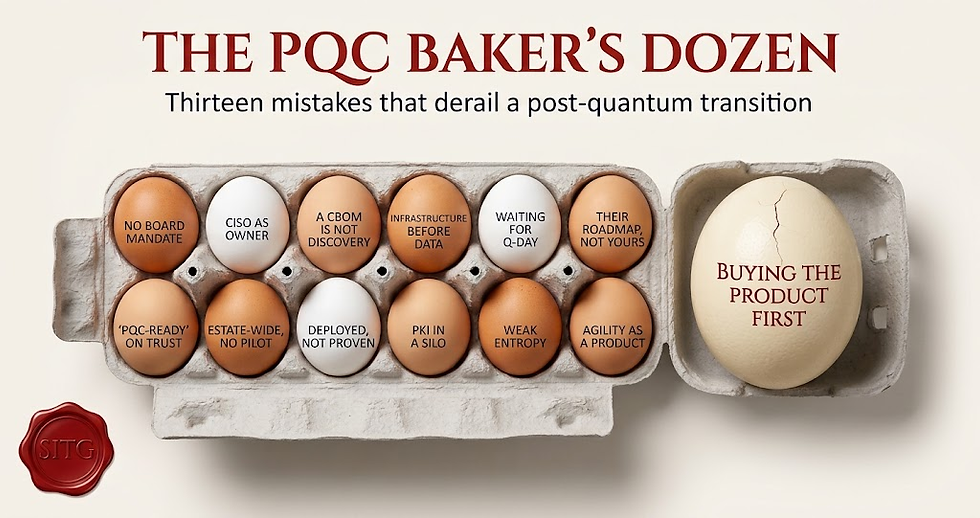
The costliest mistake in a post-quantum cryptography (PQC) transition is made before a single algorithm changes. It is buying a product first.
Each mistake below sets out what goes wrong and what to do instead, across PQC and crypto modernisation programmes, with the SITG-Consulting analysis and the primary source behind it.
1. Starting with a PQC product
A product cannot tell you where your cryptography sits. Board mandate first, discovery second, vendor fifth.
SITG-Consulting analysis: Why PQC Vendors Are Not the Starting Point for Your Post-Quantum Transition
Primary source: CISA, NSA and NIST, Quantum-Readiness: Migration to Post-Quantum Cryptography (August 2023)
2. No board mandate
Quantum risk is known and foreseeable. No mandate means no owner, no funding and no leverage over suppliers.
SITG-Consulting analysis: Quantum Is No Longer a Cyber Risk. It's a Fiduciary Duty.
Primary source: G7 Cybersecurity Working Group, Statement on preparing for a post-quantum cryptography migration (May 2026)
3. Making the CISO the owner
This is an enterprise risk programme, not a security project. Ownership sits with the Chief Risk Officer, with the Chief Information Security Officer accountable for the security controls.
SITG-Consulting analysis: Quantum Is No Longer a Cyber Risk. It's a Fiduciary Duty.
4. Treating a scan or a CBOM as discovery
Initial discovery should give you the as-is: the current state of your crypto estate, what exists, where it runs and who owns it. A cryptographic bill of materials records that state. It does not replace the work of establishing it.
SITG-Consulting analysis: Discovery Is Table Stakes for PQC. A CBOM Is Not Discovery.
Primary source: OWASP CycloneDX, Cryptography Bill of Materials
5. Starting with infrastructure, not data
Begin with the data that must stay secret longest, then trace the cryptography protecting it.
SITG-Consulting analysis: PQC Discovery Does Not Start With Infrastructure. It Starts With Data.
6. Waiting for Q-day, the day a quantum computer breaks today's encryption
Mosca's test: if data shelf-life plus migration time exceeds the time to that machine, you are already late.
SITG-Consulting analysis: Mosca's Theorem: The Equation That Tells You When to Start Post-Quantum Migration
7. Mistaking a supplier's roadmap for yours
Theirs says when a capability exists. Yours must say when your systems are ready.
SITG-Consulting analysis: PQC Roadmap vs PQC Migration Roadmap
8. Accepting "PQC-ready" without evidence
A questionnaire records a claim, not a control. FIPS 140-2 certificates moved to NIST's historical list in September 2026, so check claims against FIPS 140-3.
SITG-Consulting analysis: FIPS 140-3 Gap Analysis: What the September Deadline Exposed
Primary source: NIST, FIPS 140-3 Transition Effort
9. Going estate-wide before a bounded pilot
Hybrid is a bridge, not the destination. Agree success thresholds and rollback first.
SITG-Consulting analysis: A Vendor-Neutral Framework for Your First PQC Hybrid Pilot
10. Deploying without proving it works
Deployment is logistics. Assurance is governance. The builder should not mark its own work.
SITG-Consulting analysis: Deploying PQC Is Not the Same as Proving It Works
11. Running public key infrastructure, key management and PQC as separate projects
Public TLS certificate lifetimes fall to 47 days by March 2029 while post-quantum signatures grow fiftyfold. One programme, not three.
SITG-Consulting analysis: Why PKI, KMS and Post-Quantum Migration Can No Longer Be Separate Projects
Primary source: CA/Browser Forum, Ballot SC-081v3, Schedule of Reducing Validity and Data Reuse Periods; NIST, FIPS 204, Module-Lattice-Based Digital Signature Standard (August 2024)
12. Ignoring entropy
A post-quantum algorithm running on weak randomness is not a post-quantum implementation.
SITG-Consulting analysis: Post-Quantum Cryptography Has an Entropy Problem
Primary source: NIST SP 800-90B, Recommendation for the Entropy Sources Used for Random Bit Generation
13. Treating crypto-agility as a product
It rests on entropy, interoperability and visibility. Remove one and it fails.
SITG-Consulting analysis: Crypto-Agility Is Not the Goal
The pattern
Eight of the thirteen happen before any cryptography changes. The fix is sequence, not technology.
Board mandate first. Discovery second. Governance third. Dependency mapping fourth. Vendor selection fifth. Remediation sixth. Then deploy, test and prove it, in an order set by risk rather than commercial convenience.
SITG-Consulting provides independent PQC advisory and assurance, from board mandate through discovery to validated migration.
Brian Couzens, CEO, SITG-Consulting


Comments