
Post-Quantum Readiness Is an ESG Risk. Here’s Why We Reclassified It.


For years, almost every discussion around post-quantum cryptography has started in the same place.
Algorithms.Encryption.Standards.Migration.Cybersecurity.
That is where the industry begins.
It is also where the industry stops thinking.
It is not where the risk ends.
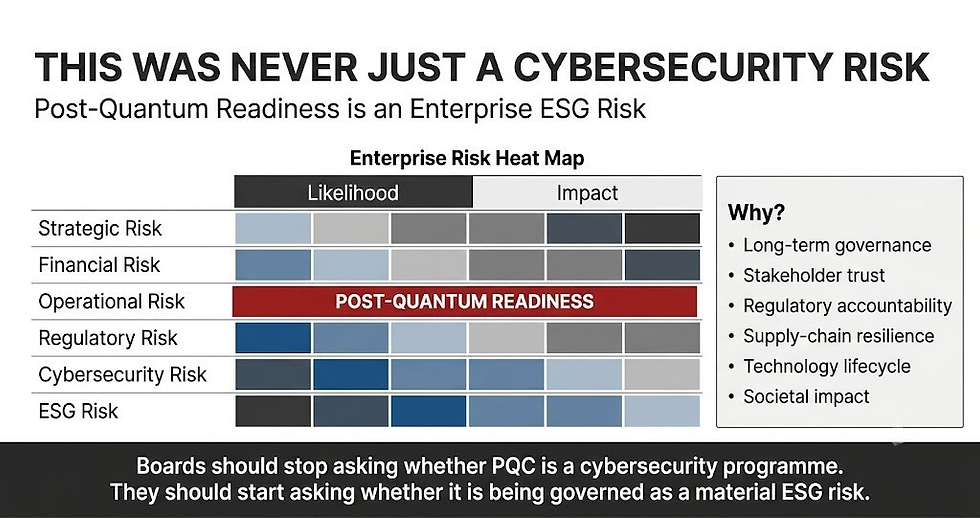
During the development of the 2026 Quantum Risk Global Doctrine, we reached a different conclusion:
Post-Quantum Readiness can no longer be classified as primarily a cybersecurity programme.
It exhibits every characteristic of a material Environmental, Social, and Governance (ESG) risk.
That conclusion changes everything.
Why ESG?
ESG is frequently misunderstood.
It is not limited to carbon emissions, sustainability reporting, or corporate social responsibility initiatives. At its core, ESG evaluates whether organisations can identify, govern, and manage material long-term risks that impact stakeholders, society, and institutional resilience.
Viewed through that lens, post-quantum readiness fits naturally.
Not because quantum computing belongs within sustainability frameworks.
But because cryptographic failure produces consequences that extend far beyond technology—into societal trust, governance accountability, and long-term systemic stability.
The Industry Is Looking at the Wrong Risk
Most organisations still classify quantum readiness as an information security issue.
That is understandable. Cryptography has historically been owned by security teams.
But cryptography does not exist to protect algorithms.
It exists to protect people, institutions, and the continuity of trust.
That distinction is critical.
Once quantum capability reaches cryptographic relevance, the impact extends across:
Healthcare systems
Financial infrastructure
Government services
Critical national infrastructure
Intellectual property ecosystems
Identity and privacy frameworks
The asset being protected is not mathematics.
It is society’s trust in digital systems.
And trust, once broken at scale, is not easily restored.
The Social Pillar Is Already Active
One of the most persistent misconceptions is that the risk begins on “Q-Day.”
It does not.
Harvest Now, Decrypt Later has already shifted the timeline.
Sensitive data is being collected today with the expectation that it will become readable in the future.
This includes:
Health records
Immigration and identity systems
Financial transactions
Legal archives
Genomic and biometric data
Some of this data has a lifespan measured in decades—or permanently.
A compromised credit card can be cancelled.
A compromised genome cannot.
Once lifetime biological or identity-linked data is exposed, the consequence is irreversible.
This is no longer a forward-looking cybersecurity scenario.
It is an active societal risk.
Governance Is Where Accountability Lives
Across global policy and regulatory developments, one signal is consistent:
Cryptographic transition is becoming a board-level responsibility.
Not a technical upgrade. Not a discretionary programme.
A governance obligation.
This direction is increasingly reflected in regulatory guidance and national quantum strategies, including:
NIST’s Post-Quantum Cryptography Standardization Programme and migration guidance
NSA’s CNSA 2.0 transition directives and interoperability requirements
The UK NCSC’s Principles for Quantum-Safe Security
EU ENISA and ETSI quantum-safe migration roadmaps
CISA’s National Quantum Strategy implementation guidance
This includes:
Cryptographic inventory and risk visibility
Funded and time-bound migration programmes
Supplier and third-party assurance
Executive ownership and accountability
Independent validation and auditability
Evidence-based reporting
Failure to migrate should therefore not be interpreted as a technical gap.
It is a governance failure.
The organisations facing the greatest future liability will not be those with the weakest encryption today.
They will be those unable to demonstrate that they governed a foreseeable risk.
The Environmental Dimension No One Is Addressing
This was one of the most unexpected findings in our research.
Delayed cryptographic migration creates a new class of risk: Cryptographic E-Waste.
When systems are not designed with cryptographic agility, organisations eventually reach a point where upgrading encryption is no longer economically or technically viable.
The result is forced replacement.
Servers
Industrial control systems
Medical devices
Network infrastructure
Embedded and IoT systems
Technology that could have remained operational becomes prematurely obsolete.
Not because of hardware failure.
But because governance failed to anticipate cryptographic evolution.
This drives:
Accelerated disposal cycles
Increased embodied carbon
Unplanned capital expenditure
Avoidable supply chain strain
The environmental cost is not quantum computing itself.
It is the consequence of delayed decision-making.
This Changes the Board-Level Question
The industry continues to ask:
“When should we deploy ML-KEM?”
That is the wrong question.
The question boards should be asking is:
“Can we demonstrate that Post-Quantum Readiness is governed as a material ESG risk?”
That requires evidence of:
Board accountability
Executive ownership
Complete cryptographic inventories
Supplier readiness and assurance
Independent validation mechanisms
Public transparency where appropriate
Measurable, time-bound progress
These are not technical artefacts.
They are indicators of governance maturity.
The Board Test
Any organisation claiming effective ESG governance should be able to answer six questions:
Have we completed a comprehensive cryptographic inventory?
Is our migration programme formally governed and funded?
Can our suppliers demonstrate quantum readiness?
Have we identified data exposed to Harvest Now, Decrypt Later risk?
Can we evidence executive accountability for migration?
Are we prepared to disclose our progress publicly?
If the answer to any of these is no, the organisation cannot credibly claim effective ESG governance.
It does not simply have a cybersecurity issue.It has an ESG governance failure.
Final Observation
The industry is still debating algorithms.
That debate is already behind us.
The real challenge is governance.
That is why Chapter 14 of the 2026 Quantum Risk Global Doctrine formally classifies Post-Quantum Readiness as a material ESG risk—with immediate social implications and clear board-level fiduciary consequences.
The algorithms may secure the future.
Governance determines who reaches it—and who does not.



Comments