
The Merkle Tree Comeback

Merkle trees are having a moment, not because they are new, but because post-quantum cryptography makes scale matter more than novelty.
This week, Let's Encrypt confirmed that Merkle Tree Certificates will form part of its roadmap for post-quantum web PKI.
At first glance this seems unusual.
Merkle Trees were proposed by Ralph Merkle almost 50 years ago and have long been regarded as a mature cryptographic construct. Yet one of the most significant challenges in post-quantum migration is not selecting an algorithm. It is deploying those algorithms at internet scale.
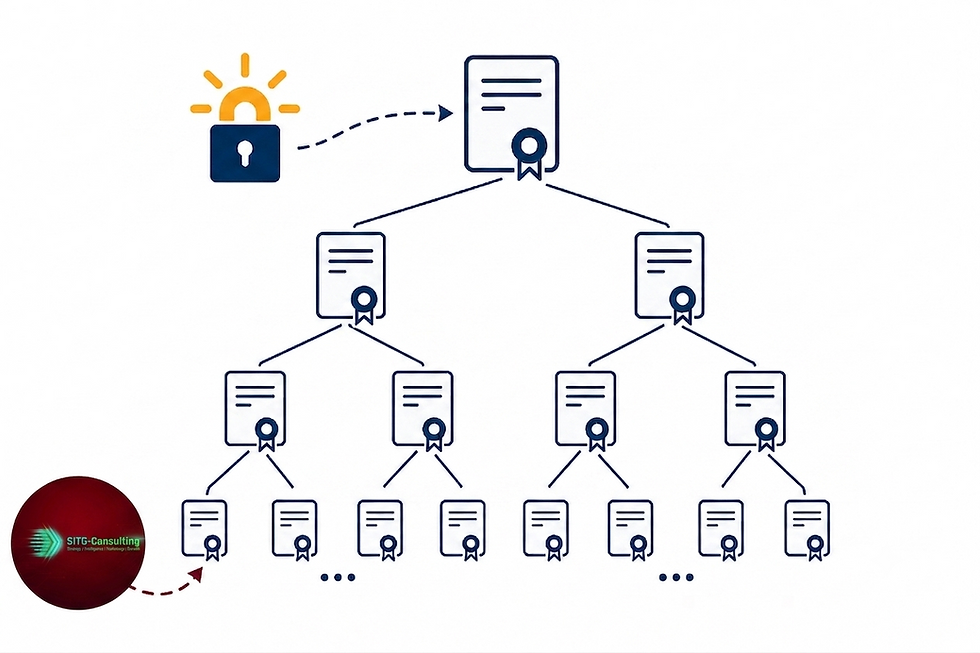
A Merkle tree is a cryptographic structure that organizes data into a tree where each node is a hash of its children. Instead of signing every certificate individually, you sign the root of the tree. Anyone can then verify that a specific certificate is included in that tree using a short proof, without needing the full tree or a separate signature for each item.
The issue is straightforward.
Traditional certificate signatures are relatively small. Post-quantum signatures are significantly larger. If deployed directly across the web at scale, certificate sizes and TLS handshake overhead increase considerably.
Let's Encrypt's approach is to use Merkle Tree Certificates, allowing a single post-quantum signature to support large numbers of certificates through a cryptographic tree structure rather than requiring every certificate to carry its own post-quantum signature.
The objective is not stronger cryptography.
The objective is scalable cryptography.
This is an important distinction.
Much of the discussion around post-quantum cryptography focuses on algorithms such as ML-KEM and ML-DSA. What Let's Encrypt's announcement demonstrates is that the next phase of the transition is increasingly an engineering and infrastructure challenge rather than a purely mathematical one.
Perhaps quantum computing has not forced us backwards after all.
Perhaps it has simply reminded us that some cryptographic ideas were decades ahead of their time.


Comments