
THE GLOBAL CRYPTOGRAPHY FAILURE

Forty Years of Warnings the Digital World Never Fully Operationalised
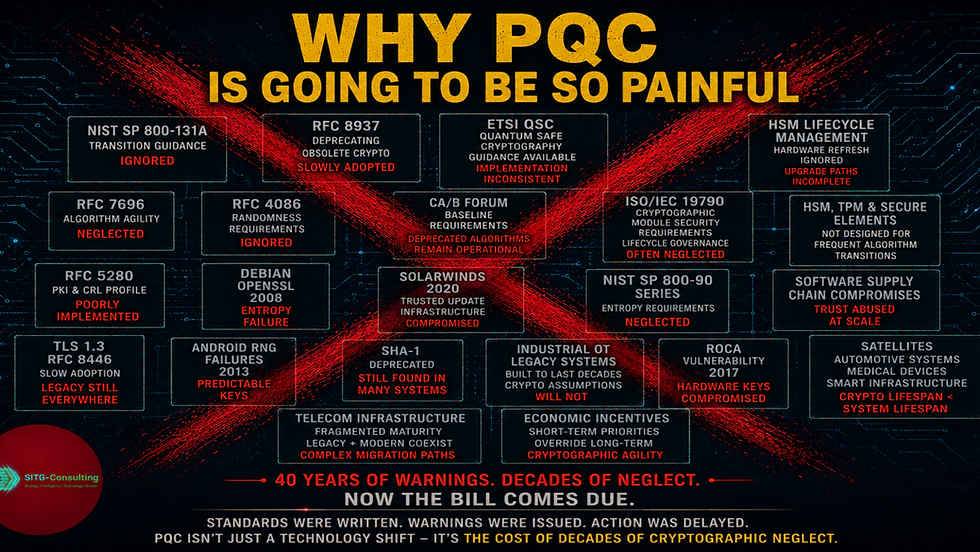
For more than forty years, cryptographers, standards bodies, protocol designers, and national cybersecurity agencies repeatedly warned that digital infrastructure needed to evolve.
Cryptography was never supposed to be static.
Algorithms were expected to age. Protocols were expected to change. Entropy systems were expected to be monitored. Certificate ecosystems were expected to become agile. Hardware security modules were expected to support lifecycle replacement. Governance frameworks were expected to maintain cryptographic visibility over time.
The standards were published.
The warnings were explicit.
Yet much of the global digital ecosystem evolved as though cryptography would remain operational indefinitely.
What the industry now calls the “Post-Quantum Cryptography transition” is not the emergence of a new problem.
It is the exposure of forty years of accumulated governance debt.
NORTH AMERICA
The Region That Wrote Many of the Rules and Still Accumulated Legacy Fragility
North America produced many of the standards that defined modern cryptographic governance.
NIST published transition guidance repeatedly. The IETF published RFCs warning about protocol rigidity. NSA migration programmes highlighted future algorithm replacement requirements decades ago.
The guidance existed.
Yet implementation across operational environments remained inconsistent.
In 2011, NIST SP 800-131A explicitly warned organisations to prepare for algorithm transition governance, maintain cryptographic inventories, and phase out vulnerable cryptographic primitives. The document effectively recognised that cryptography had lifecycle risk. Yet more than a decade later, multiple audits and reviews continued identifying incomplete crypto inventories, unmanaged certificate dependencies, and limited visibility into deployed cryptographic systems.
Impact of neglect: organisations now struggle to identify where vulnerable cryptography exists, making PQC transition planning operationally slow, expensive, and incomplete.
In 2015, RFC 7696 Algorithm Agility formally described the importance of cryptographic replacement without systemic redesign. Protocols were expected to support algorithm transition cleanly. Yet across enterprise infrastructure, industrial systems, VPN platforms, telecom environments, and embedded devices, cryptographic assumptions remained deeply hardcoded.
Consequence of neglect: hybrid PQC deployment is now vastly more complex because many systems cannot absorb new algorithms without architectural disruption.
Years earlier, RFC 5280 PKI Certificate and CRL Profile attempted to establish extensible and algorithm-independent PKI structures. In practice, many certificate ecosystems evolved around operational assumptions tied heavily to RSA and ECDSA. Parsing logic, validation paths, hardware dependencies, and certificate management tooling frequently became rigid despite the flexibility envisioned in the standard itself.
Consequence of neglect: PQC certificates and hybrid certificate chains are now causing interoperability failures across government, telecom, industrial, and enterprise environments.
The NIST SP 800-90 series repeatedly warned about entropy governance, deterministic random bit generators, entropy health testing, and validation requirements. Yet entropy failures continued appearing globally in consumer platforms, embedded systems, IoT devices, and operational technology.
THE EMPIRICAL EVIDENCE
The cryptographic governance problem was never theoretical.
Operational failures repeatedly demonstrated what happens when standards guidance is neglected or only partially implemented.
Debian OpenSSL Entropy Failure
In 2008, a Debian OpenSSL modification unintentionally removed critical entropy generation functionality, dramatically reducing the randomness of generated cryptographic keys. The result was catastrophic predictability across SSH keys, certificates, and cryptographic material generated on affected systems.
The vulnerability demonstrated that cryptographic implementations could remain operational for years while silently generating weak keys underneath trusted infrastructure.
The standards already warned about entropy quality.
The operational governance around entropy assurance failed anyway.
Android RNG Failures
In 2013, Android random number generation weaknesses contributed to cryptocurrency wallet theft and cryptographic compromise events. Poor entropy handling created predictable cryptographic conditions in real-world operational environments.
Again, the underlying issue was not absence of standards.
It was the failure to operationalise entropy governance consistently across rapidly deployed consumer ecosystems.
ROCA Vulnerability
The 2017 ROCA vulnerability exposed weaknesses in hardware-generated RSA keys affecting smart cards, TPMs, enterprise infrastructure, and government systems worldwide.
This was especially significant because it demonstrated a deeper governance issue:
hardware trust does not automatically equal cryptographic resilience.
Large numbers of organisations assumed certified hardware implied long-term cryptographic safety. Instead, the vulnerability revealed how hardware supply chain dependencies can silently concentrate systemic risk across global infrastructure.
TLS Modernisation Resistance
TLS 1.3 RFC 8446 aggressively modernised protocol security by removing obsolete cryptography and simplifying negotiation logic. Major cloud providers adopted it rapidly. Large sections of critical infrastructure did not.
Industrial systems, healthcare platforms, telecom environments, financial systems, and government networks frequently delayed migration because interoperability concerns outweighed lifecycle modernisation.
The consequence is now visible in the complexity surrounding hybrid PQC deployment.
Many environments still operate layered protocol dependencies never designed for repeated cryptographic transition.
The Broader Pattern
The pattern repeated continuously:
the standards recognised the future operational problem long before the market operationalised the solution.
The result is that North America now contains some of the world’s most advanced cyber capabilities alongside some of the world’s largest concentrations of cryptographic technical debt.
That contradiction increasingly matters as PQC migration accelerates.
EUROPE
Sophisticated Governance Frameworks Met Fragmented Operational Reality
Europe became one of the earliest regions to formally recognise that quantum-safe migration required coordinated governance.
ETSI Quantum Safe Cryptography QSC initiatives produced some of the world’s most detailed guidance around hybrid cryptography, migration planning, telecom transition models, and long-term cryptographic resilience. ENISA, BSI, ANSSI, and national cyber agencies increasingly treated cryptographic transition as a strategic infrastructure issue rather than merely a technical implementation detail.
The governance vision was advanced.
Operational reality proved far more fragmented.
The CA Browser Forum Baseline Requirements repeatedly strengthened certificate governance requirements, key sizes, and deprecation expectations. Yet older algorithms and legacy certificate chains remained operational across sectors long after deprecation guidance became available.
Consequence of neglect: many trust ecosystems now require simultaneous support for both modern and obsolete cryptography, increasing operational and governance complexity.
RFC 8937 Deprecating Obsolete Cryptography formally pushed retirement of SHA-1 and weaker RSA implementations. Despite this, legacy dependencies persisted across industrial environments, telecom infrastructure, government systems, and embedded platforms due to interoperability concerns and operational continuity pressures.
Impact of neglect: obsolete algorithms remain embedded inside operational infrastructure years after formal deprecation guidance was issued.
European telecom operators became some of the earliest adopters of ETSI quantum-safe guidance, yet the broader ecosystem still faced major fragmentation between modernised cloud-native infrastructure and long-life operational systems never designed for repeated cryptographic replacement.
Entire infrastructure classes including industrial control systems, telecom backbones, satellites, automotive platforms, medical devices, and smart infrastructure were deployed with cryptographic assumptions that may outlive the algorithms themselves.
Consequence of neglect: Europe now faces uneven PQC readiness despite advanced governance maturity.
THE EMPIRICAL EVIDENCE
Legacy SHA-1 Persistence
Despite years of deprecation guidance from browser vendors, standards bodies, and European cyber agencies, SHA-1 certificates and signing dependencies persisted across operational environments long after formal retirement recommendations were issued.
The issue was rarely technical impossibility.
The issue was operational disruption.
Organisations repeatedly delayed replacement because certificate migration impacted legacy applications, embedded systems, industrial environments, and business continuity processes.
Telecom Infrastructure Fragmentation
European telecom operators became some of the earliest adopters of quantum-safe migration planning through ETSI initiatives. Yet telecom infrastructure across Europe still varies significantly in cryptographic maturity.
Modern 5G cloud-native infrastructure frequently coexists beside legacy signalling systems, operational technology, and embedded telecom dependencies built long before PQC transition became a strategic concern.
The result is uneven cryptographic resilience across interconnected infrastructure layers.
Smart Infrastructure Lifecycle Exposure
Europe’s aggressive digitisation of transport systems, healthcare infrastructure, energy systems, automotive platforms, and industrial automation created another long-term challenge.
Many deployed systems were engineered with operational life cycles measured in decades.
But the cryptographic assumptions embedded inside those systems may not survive even a fraction of those timelines.
This creates a governance problem extending far beyond cybersecurity teams alone.
It increasingly becomes a national infrastructure resilience issue.
ASIA PACIFIC
Rapid Infrastructure Expansion Often Outpaced Lifecycle Governance
Asia Pacific built some of the most advanced digital ecosystems ever deployed.
National identity systems, hyperscale telecommunications, smart infrastructure, mobile payments, advanced manufacturing, and large-scale digital government platforms transformed the region rapidly.
But speed created trade-offs.
Operational deployment often moved faster than long-term cryptographic lifecycle planning.
RFC 4086 Randomness Requirements for Security established strong guidance for entropy generation and randomness validation years earlier. Yet across embedded systems, industrial IoT, telecom infrastructure, and consumer device ecosystems, entropy assurance frequently remained inconsistent.
Consequence of neglect: many systems implement cryptography without implementing robust entropy governance beneath it, creating hidden structural weakness.
Guidance from the Crypto Forum Research Group CFRG increasingly promoted safer curves, modular cryptographic design, and future agility planning. Yet many operational environments retained rigid cryptographic assumptions because interoperability, cost, and deployment scale dominated engineering priorities.
Impact of neglect: large infrastructure estates now face expensive migration pathways because agility was not engineered into systems from the beginning.
The industry also underestimated cryptographic dependency concentration inside software supply chains, firmware signing ecosystems, trusted update infrastructure, and secure boot architectures. Code signing, TPM trust chains, and update validation increasingly became systemic dependencies rather than isolated security controls.
Events such as SolarWinds, malicious certificate abuse, and software supply chain compromises demonstrated how cryptographic trust relationships can become systemic operational risk at global scale.
Hybrid migration capability remains uneven across the region. Some advanced economies aggressively accelerated PQC readiness programmes. Others still operate enormous estates of embedded infrastructure that cannot easily absorb algorithm replacement without operational disruption.
The issue was rarely lack of technical sophistication.
The issue was accumulated infrastructure inertia at enormous scale.
THE EMPIRICAL EVIDENCE
Software Supply Chain Concentration Risk
Modern digital ecosystems increasingly depend on trusted software update mechanisms, firmware signing, secure boot processes, and centralised certificate trust chains.
The SolarWinds compromise demonstrated how trusted update infrastructure can become a systemic attack vector capable of propagating compromise globally.
The cryptographic mechanisms functioned exactly as designed.
The governance assumptions surrounding trust relationships failed.
Embedded Infrastructure Inertia
Across Asia Pacific, massive numbers of operational systems including telecom infrastructure, smart city platforms, industrial IoT deployments, and manufacturing environments were built with cryptographic assumptions difficult to replace operationally.
Many systems were optimised for deployment scale, cost efficiency, and interoperability rather than future cryptographic agility.
The result is that replacing algorithms now often requires replacement of surrounding operational dependencies as well.
Consumer Ecosystem Scale
Asia Pacific contains some of the world’s largest mobile and connected device ecosystems.
This creates unique cryptographic governance challenges because billions of interconnected devices may contain:
inconsistent entropy quality
fragmented firmware governance
non-upgradeable components
legacy cryptographic libraries
vendor-specific trust architectures
At sufficient scale, even small governance weaknesses become systemic operational risk.
MIDDLE EAST
Transformation Accelerated Faster Than Cryptographic Governance Maturity
Large-scale digital transformation programmes across the Middle East modernised government services, telecom ecosystems, financial systems, and national infrastructure at extraordinary speed.
Much of the infrastructure deployed was highly modern by global standards.
Yet globally recognised cryptographic lifecycle problems still emerged beneath the surface.
ISO IEC 19790 Cryptographic Module Security Requirements established expectations around lifecycle management, cryptographic module governance, and upgrade capability. Yet many deployed environments globally, including high-growth regions, still accumulated hardware dependencies that complicate future PQC migration.
Consequence of neglect: hardware refresh cycles may become one of the largest blockers to large-scale quantum-safe migration.
The challenge increasingly facing the region is not whether modern infrastructure exists.
It is whether deployed infrastructure can repeatedly evolve cryptographically over decades without requiring large-scale replacement cycles.
That is a fundamentally different governance question.
THE EMPIRICAL EVIDENCE
Long Lifecycle National Infrastructure
Large-scale smart infrastructure deployments across transport, utilities, telecommunications, and digital identity ecosystems increasingly depend on embedded cryptographic trust relationships.
But many of these systems are expected to remain operational for ten, twenty, or even thirty years.
The challenge is that cryptographic standards evolve faster than infrastructure replacement cycles.
This creates the risk that operationally successful infrastructure may become cryptographically obsolete long before physical replacement is economically viable.
Hardware Dependency Concentration
Hardware security modules, secure elements, TPMs, SIM architectures, and embedded trust components increasingly form the foundation of modern digital ecosystems.
Yet many of these technologies were not originally engineered for repeated cryptographic transition at global scale.
The result is that future PQC migration may become constrained not by algorithms themselves, but by hardware replacement economics and operational dependency chains.
THE ECONOMIC INCENTIVE PROBLEM
For decades, cryptographic agility created costs without immediate commercial return.
Backward compatibility was rewarded. Rapid deployment was rewarded. Interoperability was rewarded. Low operational disruption was rewarded.
Long-term cryptographic adaptability rarely was.
As a result, many organisations optimised for short-term operational continuity while unintentionally accumulating long-duration cryptographic fragility.
The operational cost of preparedness was repeatedly judged higher than the perceived cost of neglect.
THE GLOBAL PATTERN
Across regions, sectors, and industries, the same pattern repeated for decades.
The standards identified the risks early.
The market operationalised them slowly.
Compliance frequently replaced engineering discipline. Backward compatibility repeatedly overrode agility. Cryptography was treated as static infrastructure rather than a dynamic lifecycle system. Hardware ecosystems accumulated rigidity. Cryptographic visibility remained incomplete.
Quantum computing did not create these weaknesses.
It exposed them.
The real issue now emerging is not simply whether organisations can deploy Post-Quantum Cryptography.
The issue is whether global digital infrastructure was ever designed to evolve safely in the first place.
SITG CONSULTING CONCLUSION
The cryptographic crisis now emerging was not caused by a sudden breakthrough in quantum computing.
It was created through decades of governance neglect, inconsistent operational adoption, and the widespread assumption that cryptographic infrastructure could remain static indefinitely.
The standards existed.
The warnings were published repeatedly across multiple regions, sectors, and standards bodies.
Algorithm agility was documented. Lifecycle governance was documented. Entropy assurance was documented. Hardware upgradeability was documented. Cryptographic transition planning was documented.
Yet across much of the global digital ecosystem, these warnings were neglected, deferred, minimised, or treated as future problems rather than immediate engineering and governance priorities.
What organisations are now discovering is that cryptography is not simply a security control.
It is foundational operational infrastructure.
And infrastructure neglected for decades eventually becomes systemic risk.
Post-Quantum Cryptography is therefore not merely a technology migration challenge.
It is the direct consequence of long-term cryptographic neglect becoming operationally visible.
The organisations most likely to succeed will not necessarily be those deploying new algorithms first.
They will be the organisations that understand:
where cryptography exists
how it is governed
how dependencies propagate across infrastructure
how trust relationships evolve
and whether systems were architected to absorb repeated cryptographic change over decades
The lesson emerging globally is increasingly clear:
cryptographic resilience was never only about the strength of algorithms.
It was about whether governments, vendors, operators, and enterprises treated cryptographic lifecycle governance seriously before accumulated neglect became structural fragility.
SITG Consulting believes the next era of cyber governance will be defined not by static compliance models, but by continuous cryptographic adaptability, infrastructure visibility, operational resilience engineering, and the elimination of governance neglect as an accepted operating condition.
Quantum computing may become the trigger event.
But the underlying fragility was engineered gradually through decades of tolerated cryptographic neglect.
That transition is no longer theoretical.
It has already begun.
Brian C.



Comments