
Interoperability in Post Quantum Cryptography

The Operational Fault Line of the Quantum Transition
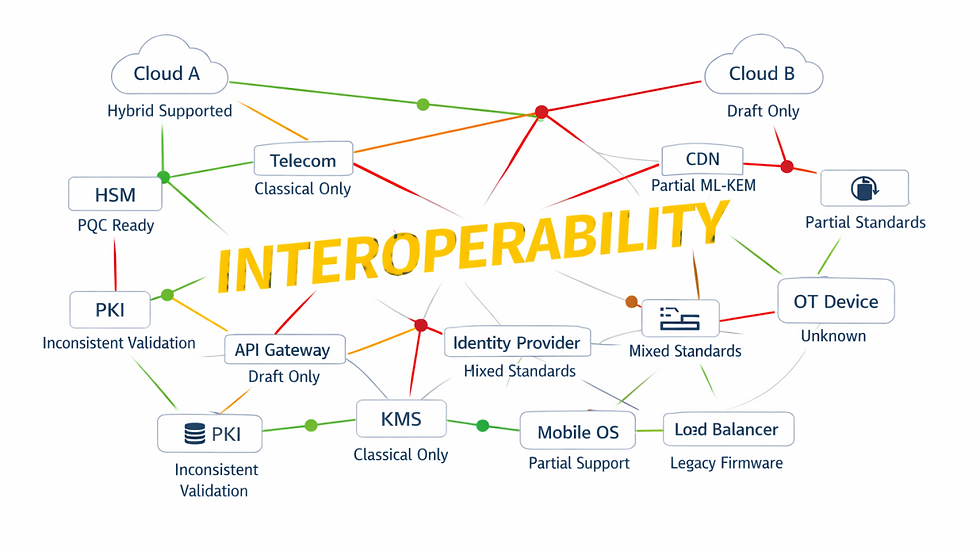
Post quantum cryptography is often discussed as if the challenge is primarily mathematical. Organisations focus on algorithms, key sizes, cryptanalytic resistance and future quantum capability. Vendors announce support for ML-KEM, ML-DSA and hybrid TLS as though algorithm availability alone represents readiness.
It does not.
The real challenge begins after the standards are published.
The operational challenge is whether those algorithms can function consistently across the interconnected reality of modern infrastructure without causing fragmentation, outages, trust collapse or systemic instability.
That is the interoperability problem.
Interoperability is where post quantum cryptography stops being a research topic and becomes an operational risk domain.
It is the point where protocols collide with infrastructure limitations, standards encounter vendor divergence, governance meets operational reality and cryptographic theory encounters business dependency chains.
A PQC algorithm can be mathematically perfect and still fail operationally if the surrounding ecosystem cannot negotiate, validate, process or trust it consistently.
Modern digital infrastructure is not a single environment. It is an interconnected trust fabric made up of:
cloud providers
telecom carriers
identity systems
APIs
PKI hierarchies
HSM ecosystems
SaaS platforms
embedded devices
industrial control systems
sovereign trust services
mobile applications
browsers
payment networks
security appliances
external suppliers
Every one of those layers must interoperate correctly during transition.
If even one layer fails, the trust chain fractures.
That is the critical distinction many organisations still fail to understand.
Cryptography does not operate in isolation. It operates inside ecosystems.
A cryptographic algorithm may be formally standardised, mathematically secure and correctly implemented, yet still fail operationally because the surrounding trust ecosystem cannot sustain the transition state required to use it safely.
This is why interoperability is emerging as one of the defining strategic risks of the quantum transition.
Not because the algorithms are weak.
But because modern infrastructure has become so interconnected, abstracted and dependency-driven that trust itself now relies on coordinated behaviour across thousands of independently evolving systems.
Article content
Classical cryptography views focus on security; operational realities focus on stability.
Interoperability Is Not a Technical Detail
One of the most dangerous misconceptions in PQC migration is the belief that interoperability is simply an engineering optimisation problem.
It is not.
Interoperability is a resilience requirement.
Under frameworks including:
DORA
NIS2
operational resilience regimes
national cybersecurity directives
financial sector resilience obligations
organisations are expected to demonstrate controlled management of technological transition risk. That includes cryptographic transition.
The moment an organisation begins deploying PQC, it inherits responsibility for ensuring that:
systems continue functioning
authentication continues working
trust chains remain valid
communications remain available
dependencies remain operational
security controls remain enforceable
Interoperability therefore becomes directly tied to:
operational continuity
governance assurance
audit defensibility
fiduciary accountability
cyber resilience obligations
This is why the issue cannot be delegated solely to engineering teams.
The interoperability problem is cross-domain.
It spans infrastructure, networking, PKI, identity, governance, procurement, risk, legal, compliance, vendor management and operational resilience.
The governance implications become even more significant when organisations recognise that PQC transition is not a contained technology refresh. It is a foundational trust transition occurring underneath live operational environments that cannot simply be shut down during migration.
Banks cannot pause payment systems. Telecom providers cannot suspend network trust. Governments cannot stop identity validation. Healthcare providers cannot interrupt secure clinical systems. Cloud providers cannot halt global authentication services while cryptographic dependencies are rebuilt.
The migration therefore occurs while critical infrastructure remains operational.
That reality fundamentally changes the nature of interoperability risk.
The organisation is not replacing one isolated cryptographic component.
It is attempting to replace the trust foundations of interconnected digital infrastructure while the entire ecosystem continues operating in real time.
What Interoperability Looks Like in Reality
Interoperability sounds abstract until you follow what actually happens inside a real operational environment.
A customer opens a banking application.
The application initiates a TLS connection.
That single connection may traverse:
a mobile OS cryptographic library
a telecom provider network
a CDN edge service
a cloud load balancer
a WAF appliance
API gateways
identity federation services
certificate validation services
internal service meshes
HSM-backed signing systems
payment processing environments
third-party fraud platforms
Every stage depends on cryptographic negotiation.
Every stage depends on trust validation.
Every stage depends on interoperability.
Introduce PQC hybrid TLS into that environment and divergence appears immediately.
The mobile device may support one hybrid interpretation. The CDN may support another. The load balancer firmware may partially support ML-KEM. The internal API gateway may reject the certificate extension. The HSM may support PQC keys while the surrounding KMS does not. The fraud provider may still rely entirely on classical PKI.
The result is operational failure.
The transaction fails. Authentication breaks. Services degrade. Trust collapses between systems.
What makes this particularly dangerous is that many of these failures do not initially appear as cryptographic failures.
They appear as:
intermittent authentication instability
unexplained latency
API degradation
inconsistent federation behaviour
random connection resets
regional service instability
certificate parsing anomalies
vendor incompatibilities
edge routing failures
This creates a major operational visibility problem.
Security teams may initially suspect compromise. Infrastructure teams may suspect networking instability. Cloud teams may suspect regional provider faults. Application teams may suspect software defects.
Meanwhile the underlying cause is cryptographic interoperability divergence occurring deep inside the trust stack.
This is one of the reasons PQC interoperability failures can become exceptionally difficult to diagnose operationally.
The organisation is not dealing with a single point of failure.
It is dealing with cascading trust inconsistencies across interconnected systems that were never originally designed to operate across hybrid cryptographic states.
The Hidden Fragility of Hybrid Transition
The transition to PQC will not happen instantly.
For years, organisations will operate in hybrid states where:
classical cryptography still exists
PQC algorithms are partially deployed
vendors support differing standards versions
certificate hierarchies contain mixed trust models
external partners migrate at different speeds
Hybrid environments create ambiguity.
A classical environment is at least consistent. A fully quantum resistant environment may eventually become consistent.
The hybrid phase is unstable by nature.
Certificate chains become larger. Negotiation logic becomes more complex. Trust validation paths multiply. Implementation variance increases. Rollback complexity increases. Monitoring visibility weakens. Troubleshooting becomes harder.
The organisation effectively operates multiple cryptographic realities simultaneously.
That creates operational strain.
But the deeper issue is that hybrid transition fundamentally changes how trust behaves inside infrastructure.
Historically, cryptographic environments evolved relatively slowly. Algorithms changed over decades. Trust anchors remained stable. Protocol negotiation paths were predictable.
PQC transition breaks that stability model entirely.
Now organisations must support:
classical trust
hybrid trust
quantum resistant trust
backward compatibility
selective downgrade handling
transitional certificate hierarchies
evolving protocol drafts
vendor-specific implementation behaviours
all at the same time.
This creates what can be described as trust-state fragmentation.
Different parts of the environment begin operating under different cryptographic assumptions simultaneously.
One environment validates a hybrid certificate. Another rejects it. One appliance supports composite signatures. Another silently strips extensions. One cloud region negotiates successfully. Another falls back to classical negotiation without visibility.
Over time, this fragmentation can become operationally dangerous because the organisation loses consistency of trust interpretation across the estate.
That loss of consistency is where interoperability risk transforms into systemic resilience risk.
Interoperability and Cryptographic Agility
This is why interoperability cannot be separated from cryptographic agility.
The two are operationally inseparable.
Cryptographic agility is often described too narrowly as the ability to swap algorithms quickly. That definition is incomplete.
True cryptographic agility is the organisational capability to sustain trust continuity while cryptographic dependencies change underneath live operational infrastructure.
That distinction matters enormously.
An organisation is not agile simply because it can technically deploy a new algorithm.
It is agile only if it can:
transition algorithms safely
preserve interoperability during migration
maintain operational continuity
avoid trust fragmentation
sustain visibility across hybrid states
contain rollback risk
coordinate dependencies across suppliers and platforms
preserve governance assurance throughout transition
Article content
True agility isn’t swapping algorithms; it’s sustaining trust across stacks.
Without interoperability, cryptographic agility collapses.
The organisation may possess technically modern cryptography while lacking the operational capability to deploy it safely at scale.
This is the hidden weakness inside many current PQC readiness claims.
Vendors often demonstrate algorithm support in controlled environments. Real agility only exists when the organisation can sustain coordinated trust behaviour across interconnected ecosystems under operational conditions.
That means agility is no longer just a technical characteristic.
It becomes:
an architectural characteristic
a governance characteristic
a supply chain characteristic
an operational resilience characteristic
A truly agile organisation must understand not only what cryptography it uses, but:
where trust dependencies exist
how negotiation paths behave
which vendors control critical interoperability points
which suppliers can force rollback conditions
where downgrade exposure exists
how failures propagate across trust boundaries
how quickly cryptographic states can be isolated during instability
This fundamentally changes the meaning of cryptographic governance.
Historically, governance focused on whether approved algorithms were being used.
Now governance must focus on whether cryptographic ecosystems can evolve safely without destabilising operational trust.
That is a far more complex challenge.
And it is why interoperability has become the operational backbone of cryptographic agility itself.
The Missing Layer: The Cryptographic Bill of Materials
One of the biggest operational gaps in current PQC transition planning is that many organisations still do not know where cryptography actually exists inside their environments.
They know where some certificates exist. They know where some PKI systems operate. They know where some HSMs are deployed.
But they do not possess a complete operational map of cryptographic dependency across the estate.
That becomes extremely dangerous during PQC transition because interoperability failures rarely originate from visible systems alone.
They emerge from hidden dependencies.
A single outdated cryptographic library embedded inside:
a mobile application
an industrial controller
a cloud workload
a firmware component
a SaaS integration
an API dependency
a third-party SDK
a hardware management plane
can become the point where operational trust fails.
This is why the concept of the Cryptographic Bill of Materials is becoming strategically important.
A Cryptographic Bill of Materials, or CBOM, extends the concept of the Software Bill of Materials into cryptographic governance.
Where an SBOM identifies software components and dependencies, a CBOM identifies:
cryptographic algorithms
certificates
trust anchors
key exchange mechanisms
cryptographic libraries
signing systems
protocol dependencies
certificate authorities
embedded cryptographic functions
hardware cryptographic dependencies
algorithm lifecycle states
across operational infrastructure.
The CBOM becomes the visibility layer required to operationalise cryptographic agility.
Without visibility, agility is impossible.
An organisation cannot transition cryptography safely if it does not understand:
where algorithms are deployed
which systems depend on them
which vendors control implementation
which trust boundaries rely on them
which systems cannot support transition
which dependencies create interoperability bottlenecks
This is one of the reasons many organisations underestimate PQC transition complexity.
They are attempting to govern cryptographic transition without a complete map of the cryptographic estate itself.
In practice, the CBOM becomes:
the discovery mechanism for interoperability governance
the dependency map for migration planning
the evidence layer for audit assurance
the operational blueprint for cryptographic agility
the visibility plane for trust dependency management
Without it, interoperability governance becomes partially blind.
Use Case One: The Financial Sector Rollback
A multinational bank deploys hybrid TLS.
Internal systems negotiate correctly. Pilot certificates validate. Production rollout begins.
External payment processors reject the hybrid chain. A telecom provider strips TLS extensions. Older customer environments fail negotiation.
Transactions fail. Authentication breaks. Rollout is suspended. Six months of migration effort is lost.
The failure is not mathematical.
It is interoperability.
But the strategic damage extends further than the failed deployment itself.
The rollback creates:
delayed migration timelines
executive confidence erosion
increased regulator scrutiny
supplier assurance disputes
operational resilience concerns
reputational exposure
internal resistance to future migration phases
The organisation becomes more cautious. Budgets tighten. Governance committees demand additional assurance evidence. External partners become hesitant to support future hybrid rollout windows.
The failed interoperability event therefore slows not only technical deployment, but organisational confidence in the transition programme itself.
This is one of the least discussed consequences of failed PQC interoperability.
Interoperability failures damage institutional trust in migration.
Use Case Two: Industrial Infrastructure Failure
An energy operator tests PQC VPN tunnels.
Algorithms function correctly. Appliances support ML-KEM.
Remote field devices operate across constrained satellite links with strict MTU limits.
Under load, fragmentation increases, retries escalate, tunnels drop and substations disconnect.
The deployment halts.
The issue is not cryptographic security.
It is infrastructure that cannot sustain PQC traffic.
This is where traditional testing models begin to fail.
Conventional validation environments rarely simulate the full operational stress conditions created by PQC transition.
Many interoperability failures only emerge when:
packet sizes increase under sustained load
renegotiation frequency escalates
constrained devices experience memory pressure
fragmented traffic traverses legacy inspection systems
hybrid trust states interact unpredictably across vendors
This is why organisations increasingly require what can be described as crypto chaos engineering.
Just as chaos engineering intentionally stresses distributed systems to expose hidden operational fragility, crypto chaos engineering intentionally stresses cryptographic infrastructure under PQC conditions.
This includes:
injecting oversized PQC packets
forcing repeated hybrid renegotiation
simulating downgrade attacks
emulating certificate parsing failures
testing fragmented MTU conditions
introducing trust boundary instability
stress testing hybrid rollback behaviour
The objective is not merely to confirm that PQC functions under ideal conditions.
The objective is to discover precisely where operational trust collapses before production deployment occurs.
In many cases, crypto chaos testing becomes the only reliable method for identifying hidden interoperability fragility across complex environments.
What makes industrial environments especially difficult is that operational technology infrastructure often remains deployed for decades.
Many OT environments were never designed for:
large certificate chains
high-frequency renegotiation
larger key exchange payloads
memory-intensive cryptographic processing
modern hybrid trust models
Replacing those environments is not trivial.
In many cases:
hardware cannot be upgraded easily
firmware support is limited
operational downtime windows are constrained
vendor support lifecycles are inconsistent
safety certification dependencies exist
This means interoperability risk becomes entangled with physical infrastructure lifecycle risk.
The cryptographic transition is no longer just digital.
It becomes operational, industrial and economic.
Use Case Three: The Cloud Trust Boundary Problem
A global enterprise operates across multiple cloud providers.
Each implements hybrid certificate handling differently.
Cross-cloud identity federation begins failing intermittently. Authentication becomes unpredictable. Security teams suspect compromise.
The cause is standards divergence.
The failure is interoperability.
This scenario becomes even more dangerous at scale because cloud abstraction hides underlying trust complexity from customers.
An organisation may believe it operates a unified identity architecture while multiple independent trust interpretations exist underneath different cloud control planes.
This creates invisible fragmentation.
Everything appears operational until:
federation tokens fail
certificate validation paths diverge
service meshes reject negotiation
regional trust anchors behave differently
APIs interpret hybrid states inconsistently
At that point the organisation discovers that trust consistency was assumed rather than validated.
That discovery often occurs during production impact.
Why Standards Alone Do Not Solve the Problem
There is a dangerous assumption emerging across parts of the industry that once standards are finalised, interoperability naturally follows.
History repeatedly shows this is false.
Standards reduce ambiguity.
They do not eliminate implementation divergence.
Vendors optimise differently. Protocol handling varies. Firmware maturity differs. Certificate parsing diverges. Memory constraints alter behaviour. Regional compliance obligations introduce modification. Cloud providers create proprietary abstractions.
Interoperability must be operationally proven, not assumed.
This is particularly important because PQC transition is occurring globally across sovereign, commercial and industrial environments simultaneously.
Different nations will:
prioritise different standards
adopt different timelines
certify different implementations
impose different regulatory requirements
approve different trust models
Over time this may create sovereign interoperability divergence where globally interconnected systems operate under partially incompatible cryptographic assumptions.
That possibility introduces geopolitical dimensions to interoperability risk.
The Risk of Premature Optimisation
One of the emerging dangers in PQC migration is the pressure to deploy early simply to demonstrate progress.
Organisations increasingly fear being perceived as unprepared for the quantum transition. Vendors increasingly market early PQC capability as a competitive differentiator. Governments increasingly encourage accelerated migration planning.
This creates a dangerous incentive structure.
Some organisations may begin deploying partially mature hybrid implementations before interoperability standards stabilise operationally across the wider ecosystem.
That creates long-term fragmentation risk.
A hybrid implementation deployed today may later conflict with:
revised protocol drafts
evolving certificate profiles
updated interoperability guidance
vendor implementation changes
sovereign regulatory requirements
finalised standards behaviour
The result is not accelerated resilience.
It is technical debt embedded directly into trust infrastructure.
This is particularly dangerous because cryptographic infrastructure tends to persist for years once deployed into production environments.
An organisation that rushes into non-standardised or poorly governed hybrid deployment may later discover that:
rollback is difficult
certificate replacement is disruptive
downstream systems cannot adapt
interoperability assumptions were incorrect
suppliers implemented incompatible behaviours
operational dependencies became locked into unstable transition states
This is why PQC transition must be governed strategically rather than emotionally.
The objective is not to become first.
The objective is to preserve long-term trust continuity safely.
Poorly coordinated acceleration may ultimately increase the very interoperability fragmentation organisations are attempting to avoid.
The Operational Playbook
Interoperability cannot be governed passively.
It requires structured operational discipline.
As PQC migration accelerates, organisations increasingly require a repeatable operational framework capable of translating interoperability theory into measurable resilience practice.
That framework begins with visibility.
1. Discover
Organisations must first identify where cryptography exists across the environment.
This requires:
cryptographic discovery
dependency mapping
trust boundary identification
certificate inventory analysis
protocol visibility
embedded cryptographic assessment
vendor dependency identification
This is where CBOM capability becomes operationally critical.
Without continuous visibility into cryptographic dependencies, interoperability governance becomes reactive rather than controlled.
2. Assess
Once dependencies are visible, organisations must pressure-test operational readiness across the ecosystem.
This means evaluating not merely whether vendors claim PQC support, but:
how hybrid negotiation behaves operationally
how rollback functions under failure conditions
how certificate chains behave during transition
how cloud platforms interpret hybrid trust states
how constrained infrastructure behaves under load
how suppliers handle interoperability divergence
The important question is no longer: “Does the vendor support PQC?”
The important question becomes: “How does the vendor preserve operational trust continuity during hybrid transition?”
That is a fundamentally different governance question.
3. Isolate
Not every system can transition simultaneously.
Organisations therefore require controlled trust segmentation strategies.
This includes:
PQC termination zones
cryptographic translation boundaries
isolated interoperability gateways
segmented trust domains
controlled downgrade corridors
vendor isolation patterns
Without segmentation, interoperability failures may cascade across operational infrastructure.
Isolation limits blast radius.
4. Validate
Interoperability assumptions must be continuously tested under operational conditions.
Validation cannot rely solely on vendor certification.
It must include:
cross-vendor negotiation testing
hybrid certificate validation
downgrade scenario testing
rollback simulation
constrained infrastructure stress testing
multi-cloud trust validation
third-party dependency testing
Operational trust must be proven repeatedly, not assumed once.
5. Govern
Finally, interoperability must become part of formal resilience governance.
This requires:
executive accountability
board visibility
supplier assurance programmes
audit evidence retention
interoperability risk reporting
policy enforcement
migration oversight structures
At scale, PQC interoperability becomes a permanent operational discipline rather than a temporary migration exercise.
How Interoperability Is Governed, Controlled and Proven
Interoperability is not a technical task.
It is a governed control domain that determines whether PQC migration is possible at all.
1. Ownership
A single accountable owner must exist.
This is normally:
the CISO
the Head of Cryptographic Services
the executive responsible for trust infrastructure
They own:
the interoperability strategy
the control framework
the validation schedule
the dependency map
the reporting line to the board
Without ownership, interoperability gaps remain invisible.
2. The Control Plane
Interoperability requires formal controls that can be tested and evidenced.
Controls must exist for:
cryptographic inventory completeness
protocol and handshake dependency mapping
certificate chain compatibility
vendor implementation maturity
constrained device behaviour
hybrid and non-hybrid negotiation
cross-boundary interoperability with external partners
regression testing after vendor updates
monitoring of vendor deprecations or behavioural changes
compensating controls for unsupported systems
Each control must have:
an owner
a testing method
a testing frequency
required evidence
3. How It Connects to the Stack
Interoperability touches every layer of the stack.
Application layer: certificate parsing, API trust boundaries
Identity layer: federation, token signing, OCSP, CRLs
Network layer: MTU, fragmentation, handshake behaviour
Transport layer: TLS, QUIC, SSH, IKEv2
Hardware layer: HSMs, TPMs, secure enclaves
Cloud layer: load balancers, service meshes, gateways
Edge layer: CDNs, telecom networks, mobile OS libraries
OT layer: constrained devices, legacy firmware
If any layer cannot negotiate PQC, the entire path fails.
4. Continuous Monitoring
Interoperability is not static.
Vendors release updates. Cloud providers change behaviour. Telecom carriers modify inspection rules. Browsers deprecate algorithms. HSM firmware evolves. Certificate profiles change.
Continuous monitoring must track:
vendor support changes
protocol deprecations
certificate profile updates
handshake failures
negotiation anomalies
MTU fragmentation patterns
cross-boundary failures
external partner readiness
Monitoring must be real time and tied to incident response.
5. What Happens When a Vendor Turns Something Off
This is the scenario many organisations ignore.
If a vendor disables a hybrid mode, changes certificate parsing, modifies handshake behaviour or updates firmware in a way that breaks PQC negotiation:
authentication can fail
external integrations can break
identity federation can collapse
payment flows can stop
service meshes can fail
VPN tunnels can drop
monitoring visibility can degrade
This is why interoperability must be continuously validated.
6. Compensating Controls and DR Patterns
When interoperability cannot be guaranteed, compensating controls must exist.
These include:
controlled downgrade paths
dual certificate hierarchies
fallback negotiation profiles
isolated trust boundaries
vendor isolation zones
controlled rollback procedures
PQC readiness gates for suppliers
disaster recovery plans for cryptographic failure
Cryptographic DR is now a real requirement.
A failed PQC rollout can cause an outage equivalent to a major cyber incident.
7. Audit Evidence
Interoperability must be auditable.
Evidence must include:
the interoperability matrix
test results
vendor readiness statements
failure logs
rollback records
dependency maps
board reporting
supply chain readiness assessments
This is what regulators will ask for.
The Supply Chain Reality
No organisation transitions to PQC independently.
Every organisation is constrained by the readiness of:
suppliers
software vendors
cloud platforms
telecom providers
hardware manufacturers
identity providers
external APIs
managed service providers
This creates a systemic dependency problem.
An organisation may be fully prepared internally and still remain operationally blocked because a critical third party cannot interoperably support transition.
That creates:
migration bottlenecks
asymmetric readiness
fragmented trust states
extended hybrid exposure
operational unpredictability
The transition therefore becomes ecosystem-wide rather than organisational.
This also fundamentally changes procurement governance.
Historically, organisations purchased technology based on:
functionality
performance
security certification
availability
commercial cost
Now they must increasingly evaluate vendors based on interoperability survivability during cryptographic transition.
That introduces an entirely new category of supplier assurance requirement.
Organisations may soon need contractual PQC interoperability obligations covering:
hybrid negotiation stability
rollback support
standards alignment
certificate lifecycle compatibility
interoperability testing participation
transition roadmap transparency
notification obligations for protocol changes
operational resilience commitments during migration
In effect, interoperability itself becomes commercially material.
Vendors that cannot demonstrate stable transition behaviour may eventually become operational liabilities within regulated environments.
The Governance Position
Interoperability is not a technical preference.
It is a governance requirement.
It determines whether PQC migration is possible.
It determines whether retroactive decryption risk is mitigated.
It determines whether cryptographic solvency is preserved.
Algorithms may be mathematically sound.
Standards may be formally approved.
Vendors may declare support.
But if systems cannot negotiate, validate, authenticate and operate consistently across interconnected operational environments, then cryptographic transition fails in practice.
At that point PQC ceases to be a resilience programme.
It becomes a source of systemic fragility.
That is why interoperability is not a side issue in post quantum cryptography.
It is the operational fault line of the entire quantum transition.
The SITG-Consulting Mandate for PQC Governance
Mathematically secure algorithms alone do not guarantee resilience. If the surrounding ecosystem cannot negotiate, validate, and sustain trust consistently under operational conditions, the system collapses.
This is why SITG-Consulting views PQC migration not as a technical refresh, but as a live operational resilience domain tied directly to fiduciary defensibility and supply chain survivability.
To maintain what we call cryptographic solvency, our position is that interoperability must be rigorously governed across five distinct lifecycles:
Continuously Validated: Shifting from point-in-time audits to continuous cryptographic discovery using a Cryptographic Bill of Materials (CBOM).
Operationally Stress-Tested: Utilizing crypto chaos engineering to intentionally inject large PQC packets and simulate high-frequency renegotiation failures before production impact.
Contractually Governed: Demanding clear PQC hybrid negotiation roadmaps and interoperability SLAs from the vendor ecosystem.
Auditably Evidenced: Simulating downgrade attacks and cross-vendor trust divergence to prove resilience to regulators (DORA, NIS2).
Actively Monitored: Tracking trust-state fragmentation across live, interconnected cloud and identity boundaries.
The Fault Line: Rushing to deploy incomplete hybrid states creates immediate interoperability debt. If operational trust cannot survive the transition state, the math won't save you.



Comments