
Find the Crown Jewels Systematically: A Strategic Guide to Post-Quantum Cryptographic Discovery

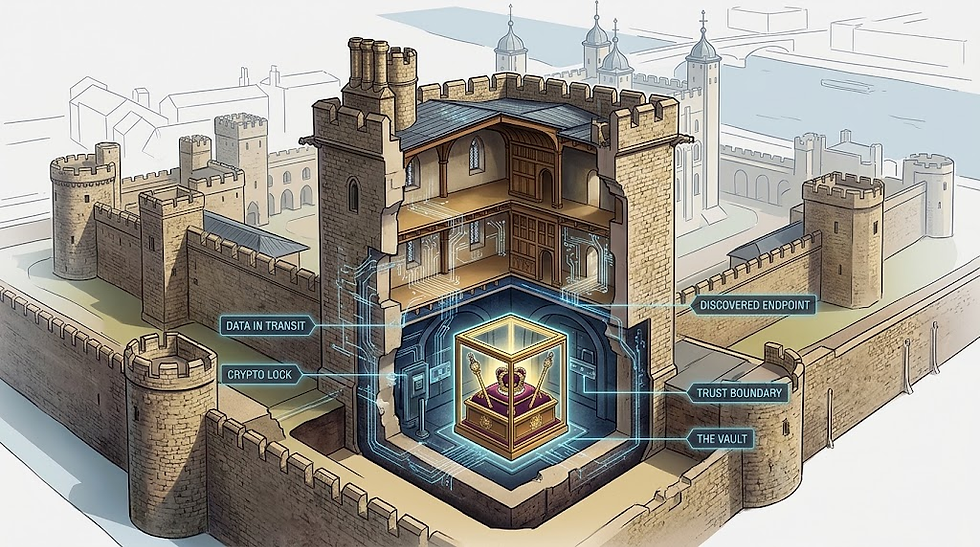
Data is the Crown Jewel. Infrastructure is the vault. Cryptography is the lock on the door. Achieving post-quantum resilience requires mapping the physical and virtual real estate handling high-value data.
The primary risk today is not a distant future quantum computer. The risk is active Harvest Now, Decrypt Later (HNDL) operations targeting data with long confidentiality lifetimes. Adversaries systematically capture encrypted network traffic, storing raw payloads until sufficient fault-tolerant quantum capacity emerges to break classical asymmetric algorithms like RSA-2048 and Elliptic Curve Cryptography (ECC).
Security teams often struggle to prioritize their Post-Quantum Cryptography (PQC) migration because they start at the wrong end: evaluating algorithms rather than inventorying assets. True resilience starts by systematically discovering where cryptographic exposure lives across your entire enterprise footprint.
The CMDB Fallacy: Why Your Current Inventory Is Incomplete
Security executives frequently rely on static Configuration Management Databases (CMDBs) and architectural diagrams to understand their security posture. However, empirical network audits consistently reveal recurring gaps between documented inventories and live network telemetry.
Static asset registers decay rapidly in modern, fast-moving environments. Production networks routinely house undocumented API integrations, legacy appliances, shadow cloud services, and forgotten operational technology (OT).
In a post-quantum transition, invisible systems represent structural liabilities:
Signing Certificates: An unmapped firmware signing key allows adversaries to forge updates once quantum capacity breaks the underlying algorithm.
Orphaned Gateways: An forgotten VPN endpoint bypasses modern network controls while relying on vulnerable key exchanges.
Shadow APIs: Unregistered endpoints transmitting customer data create quiet data leakage channels susceptible to HNDL interception.
An unmapped hardware module or forgotten signing certificate creates material exposure that invalidates otherwise robust PQC roadmaps.
Mapping Cryptographic Exposure Across Four Operational Domains
Effective discovery requires moving past high-level software lists. Cryptographic exposure spans distinct operational domains across modern hybrid environments:
☁️ Cloud & Identity
Federated identity providers (IdPs) and OAuth tokens
Cloud Key Management Service (KMS) instances
Container orchestrators and service mesh ingress controllers
🖥️ Core Infrastructure
Blade servers and hypervisors
Core routing engines and load balancers
High-throughput storage arrays and backup appliances
⚙️ Operational Technology (OT)
Industrial gateways and SCADA interfaces
Programmable Logic Controllers (PLCs)
Power management and distribution units
🛡️ Facility & Trust Boundaries
Smart badge readers and access controllers
HVAC and environmental management systems
Hardware Security Modules (HSMs) and VPN concentrators
If a system negotiates key exchanges, signs firmware, or validates digital identity across a trust boundary, it carries cryptographic exposure.
Technical Precision: Asymmetric Fragility vs. Symmetric Strength
Not all cryptography fails equally under quantum pressure. Understanding the distinction is vital for accurate risk mapping and resource allocation:
The Vulnerability of Asymmetric Algorithms
Classical asymmetric key establishment, digital signatures, and traditional Public Key Infrastructure (PKI) rely on mathematical problems—such as integer factorization and discrete logarithms—that Shor's algorithm solves efficiently. Systems relying on RSA, Diffie-Hellman, or ECC will require complete structural replacement.
The Durability of Symmetric Primitives
Symmetric encryption algorithms like AES-256 absorb the quadratic efficiency gains of Grover's algorithm while maintaining safe security margins. While key lengths must remain strong (e.g., preferring AES-256 over AES-128), symmetric ciphers do not require immediate structural replacement.
+--------------------------+---------------------------------+-------------------------------+
| Cryptographic Type       | Core Algorithms                 | Quantum Threat Level          |
+--------------------------+---------------------------------+-------------------------------+
| Asymmetric Key Exchange  | RSA, DH, ECDH                   | High (Requires Replacement)   |
| Digital Signatures       | RSA, ECDSA                      | High (Requires Replacement)   |
| Symmetric Encryption     | AES-256                         | Low (Absorbs Grover's Speed)  |
| Cryptographic Hashing    | SHA-256, SHA-3                  | Low (Requires Sufficient Bits)|
+--------------------------+---------------------------------+-------------------------------+
Overcoming Operational Friction in PQC Migration
Significant friction exists between executive compliance demands and operational reality. Where leaders push for rapid migration, engineering and site reliability teams resist modifying tightly coupled legacy architectures—especially those lacking active vendor support or original source code.
Replacing cryptographic primitives in these environments without comprehensive dependency mapping introduces severe operational risks:
Broken Workflows: Upgrading a certificate or library can unexpectedly break legacy service-to-service communications.
Unplanned Outages: Incompatible key sizes or handshake protocols can reject legitimate traffic at the edge.
Hidden Vulnerabilities: Flawed implementation of new PQC standards during rapid rollouts can leave systems exposed to side-channel attacks.
Systematic discovery bridges this gap by providing engineering teams with exact dependency maps before code or hardware changes occur.
Continuous Discovery as an Operational Discipline
Discovery is not a static audit or a one-time project. It is a continuous operational discipline that combines automated scanning with physical and contextual validation.
Multi-Layer Discovery Strategy
Procurement Logs: Reveal what hardware and software assets were purchased.
Facilities Records: Document physical installations across data centers and corporate sites.
Live Packet Inspection: Captures active network communications, handshake negotiations, and cipher suite negotiations.
Physical Audits: Identify dormant OT systems, legacy hardware, and air-gapped devices that passive network monitoring misses.
Conclusion: Data-Backed Risk Management
You cannot secure Crown Jewels you cannot see. Attempting to build a post-quantum migration strategy without absolute asset visibility leads to wasted capital, unmitigated exposure, and operational disruption.
Mapping asymmetric cryptographic dependencies across your complete footprint transforms post-quantum preparation from speculative guessing into a structured, data-backed risk management process. Start with discovery, map your dependencies, and build your transition plan on production reality.
authored by Clauden and Brian


Comments