
Anatomy of a PQC Denier:

How “The Machine Doesn’t Exist” Became a Strategy for Doing Nothing

PQC denial doesn’t look like a typical internet conspiracy theory. It doesn’t scream on dark web forums; it wears a tailored suit, speaks with a polished executive drawl, and masquerades as "reasonable, pragmatic risk management." It sounds like someone who has read a few academic papers, knows the current hardware constraints, and wants you to believe quantum risk is just a sci-fi distraction cooked up by vendors to hit quarterly sales targets.
But scratch the surface of this corporate cynicism, and you find the exact same cognitive architecture that fuels every classic conspiracy theory: the cherry-picking of anomalies, the dismissal of institutional consensus, and a stubborn demand for absolute, unassailable proof before taking a single step.
The target of their derision isn't just a technology; it is the systematic, historically verified progress being made by international standards bodies and government agencies.
Below is the definitive anatomical breakdown of the PQC denier ecosystem, unmasking the core rhetorical moves they use to justify strategic paralysis, the broader "bestiary" of denier archetypes, and exactly why their arguments collapse under professional scrutiny.
Part I: The Anatomy of a Critique (Deconstructing the Standard Specimen)
1. The Binary Fallacy: “The Machine Doesn’t Exist”
The Denier’s Move
“It assumes a Cryptographically Relevant Quantum Computer (CRQC) exists or is imminent. It does not.”
This is the oldest trick in the book: treating a probabilistic, time-dependent cryptographic risk as a simple binary light switch (it either exists today, or it doesn’t). They deliberately ignore that cryptographic risk is tied to data lifetime, not today’s available hardware.
Why it Collapses
Long-lived secrets don’t care whether the machine exists today. They care whether it exists before the data expires. This is structured mathematically by Mosca’s Theorem.
Let:
D = The shelf-life of your data (how long it must remain secure).
M = The migration time required to re-engineer your infrastructure to PQC.
Q = The timeline until a CRQC is operational.
If D + M > Q, you have already failed.
The moment D + M exceeds Q, you are exposed to Harvest Now, Decrypt Later (HNDL) today. The denier collapses a multidimensional mathematical equation into a single, short-sighted question: "Can I buy a quantum computer at Best Buy today?" If the answer is no, they advocate for structural paralysis.

Article content
2. The Physics Shield: Cooling, Helium 3, and “Impossible Engineering”
The Denier’s Move
“This isn't a fixable engineering issue with a bigger budget, it's a materials supply and thermodynamics problem.”
The denier leans heavily on high-school physics to imply that the scaling of quantum hardware is a physical impossibility, pointing to the scarcity of Helium 3 and the extreme cooling requirements of dilution refrigerators. This is pure rhetorical sleight-of-hand.
Why it Collapses
This argument relies on a massive, outdated technical blind spot. It assumes that the entire global quantum trajectory is permanently tethered to superconducting qubits that require near-absolute zero cooling.
It completely ignores the rapid empirical scaling of alternative quantum modalities that bypass these exact thermodynamic limitations:
Neutral Atom Computing: Utilizes lasers to trap atoms at room temperature.
Trapped Ion Architecture: Scales via electromagnetic fields without requiring massive cryogenic infrastructure.
Silicon Photonics: Routes quantum information via light, operating under significantly relaxed cooling constraints.
To declare PQC governance useless because superconducting machines face cooling bottlenecks is the modern equivalent of declaring the digital age impossible in the 1950s because the world was running out of vacuum tubes. Physics said no right up until engineering said yes.
3. The Misframed HNDL Argument: Shrink the Problem Until It Disappears
The Denier’s Move
“Migrating future communications to PQC by 2031 doesn't retroactively protect anything already captured. The race for already-stolen data is over.”
The denier admits HNDL is real, then guts its strategic significance. Since we've already lost some legacy data to adversary interception, why bother fixing the pipes now? This is technically true and strategically useless.
Why it Collapses
HNDL is an ongoing operational reality, not a historical event. State-sponsored actors are actively intercepting and storing encrypted data packets globally. Every day an enterprise delays implementing post-quantum key exchange (like ML-KEM), the volume of future compromised data expands exponentially.
The fact that some data is already lost does not justify losing the rest. The denier’s logic is a textbook cognitive failure: “We already had one warehouse fire, so installing a sprinkler system for the rest of the campus is a waste of money.” It’s not analysis; it’s nihilism dressed as pragmatism.
4. The Weaponized Basics Argument: “Identity Is the Real Problem”
The Denier’s Move
“62 percent of breaches involved the human element. None of these attacks would have been prevented by PQC.”
This is the denier’s strongest rhetorical weapon: using immediate, messy operational failures like phishing, compromised credentials, or MFA fatigue to invalidate long-term structural engineering.
Why it Collapses
This is a textbook category error. Identity and authentication are runtime, operational controls. Cryptography is a data-plane control.
Attack Vector
Current Defensive Layer
Quantum Vulnerability (CRQC)
Phishing or Credential Theft
Identity Threat Detection or FIDO2
Unchanged (PQC does not solve human error)
Passive Eavesdropping or Interception
TLS 1.3 or IPsec (RSA or ECC)
Total Compromise via Shor's Algorithm
Pointing to a high percentage of identity breaches to dismiss PQC is like building an un-phishable front door, but leaving the entire back wall made of cheap glass because "statistically, most intruders use the door." The denier collapses the priority stack into a false choice: "Fix identity OR prepare for PQC." The correct stack is an AND, not an OR. You sequence them correctly: identity is urgent; PQC requires long-term architecture that must start early.
5. The Timeline Trick: Declare All Deadlines Impossible
The Denier’s Move
“The deadline is mathematically incoherent. This is not a plan. It's a wish.”
The denier attacks the strategy's timeline by finding a single flawed, overly aggressive, or poorly executed government milestone, and uses it to claim that the entire transition framework is an unworkable fantasy.
Why it Collapses
Identify one bad plan, use it to argue the entire domain is unworkable, conclude that PQC migration is inherently pointless.
Bad execution does not equal an invalid strategy.
The broader cryptographic community isn't operating on a "wish" it is operating on hard, binding regulatory clocks. Following an exhausting eight-year international vetting process, NIST officially finalized its core PQC standards (FIPS 203 ML-KEM, FIPS 204 ML-DSA, and FIPS 205 SLH-DSA). Furthermore, the NSA’s CNSA 2.0 mandate has explicitly set a hard acquisition gate on January 1 2027: any new software, firmware, or networking equipment deployed within U.S. National Security Systems must natively support PQC parameters or they cannot be procured.
6. The Agility Mirage: Pretend Agility Is Impossible Everywhere
The Denier’s Move
“Almost nothing in the federal weapons inventory is agile. Agility is a pipe dream.”
Or increasingly:
“Crypto agility only exists because NIST isn't confident its own algorithms will survive.”
Because retrofitting cryptographic agility into a 30-year-old fighter jet, industrial control system, or legacy mainframe is incredibly difficult, the denier concludes that striving for crypto agility across modern enterprise networks is a fool's errand. Others go a step further, claiming that crypto agility itself is evidence that the new post-quantum algorithms are fundamentally broken. This is denial disguised as realism.
Why it Collapses
Crypto agility was not invented for Post Quantum Cryptography. It has been recognized as a fundamental security engineering principle for more than two decades because cryptography has never been static.
Algorithms evolve. Cryptanalysis improves. Key lengths increase. Standards mature. Business requirements change.
Security engineering has always assumed that today's cryptography will eventually be replaced by something better. That is precisely why organizations have already migrated repeatedly throughout modern computing history:
DES to Triple DES
Triple DES to AES
SHA 1 to SHA 2
RSA 1024 to RSA 2048 and larger keys
RSA to Elliptic Curve Cryptography across much of the Internet
None of those transitions happened because standards bodies lacked confidence in their work. They happened because security engineering is a continuous process rather than a destination.
Crypto agility exists so that when mathematics, regulation, implementation experience, or new attack techniques require cryptographic change, organizations can adapt without rebuilding entire technology estates.
Quantum computing did not create the need for crypto agility; it simply proves why the recommendation was correct all along.
Claiming crypto agility exists because NIST expects ML-KEM or ML-DSA to fail is like claiming software patching proves operating systems are fundamentally broken, or aircraft maintenance schedules prove aircraft cannot be trusted. Agility is not evidence of weakness. It is evidence of mature engineering.
Ironically, the organizations arguing against crypto agility are often the exact same organizations complaining about decades of accumulated technical debt.
Article content
7. The Procurement Cynicism: Everything Is Theatre
The Denier’s Move
“This reads like what happens when a distant threat collides with vendors with PQC products to sell.”
The denier closes with the classic cynic’s flourish: reduce PQC strategy to vendor theatre, reduce quantum risk to hype, reduce governance to bureaucracy, and reduce migration to waste. Once everything is theatre, nothing requires action. This is how denial becomes policy.
Why it Collapses
Reducing the consensus of NIST, the NSA, CISA, and the global cryptographic community to "vendor theater" is a classic conspiratorial mechanism: if the facts don't fit your worldview, invent a cabal of hidden actors who profit from it.
The push for PQC isn't driven by startups trying to hit venture capital milestones. It is driven by the stark, unyielding reality of asymmetric mathematics. If an adversary builds a CRQC and your public-key infrastructure is still running on classical RSA or Elliptic Curve cryptography, the cost to defend your environment becomes infinitely high.
Part II: The Extended Bestiary of Quantum Denial
The corporate cynic is only one flavor of denier. The moment a foundational shift like PQC occurs, it triggers a predictable, multi-headed hydra of resistance across different sectors, ranging from academic pedantry to full-blown, reality-warping pseudoscience.
8. The Web3 Ideologue (The "Ontological" Denier)
The Argument
“Quantum mechanics is a fundamentally flawed theory. If it were real, someone would have already used it to drain Bitcoin’s genesis block.”
The Move
Treating a software protocol or asset class not as a piece of engineering, but as an immutable law of nature.
The Collapse
Assuming a peer-to-peer software protocol dictates the quantum mechanical properties of the physical universe is textbook main-character syndrome.
If an adversary builds a CRQC, they won't advertise it by abruptly crashing the crypto markets. They will quietly target the underlying ECDSA used to sign transactions, deriving private keys from public keys on the ledger in minutes.
This isn't risk management; it’s an asset-protection coping mechanism disguised as physics.
9. The Infrastructure Veteran (The "Symmetric Safety" Misdirector)
The Argument
“AES 256 and SHA 256 are quantum-resistant. Grover’s algorithm only halves the security of AES, leaving it mathematically unbreakable. Therefore, our encryption is perfectly fine.”
The Move
Intentionally conflating symmetric encryption with asymmetric key exchange to deliberately confuse leadership and avoid infrastructure overhauls.
The Collapse
Yes, AES 256 is safe. But how do you securely distribute that AES key across the public internet? You use asymmetric algorithms like RSA or ECC.
If a quantum computer breaks the key exchange tunnel via Shor's Algorithm, the strength of the AES 256 payload inside it is completely irrelevant, the attacker already has the key.
This is the equivalent of boasting about having an un-pickable bank vault while sending the combination to the bank on a public postcard.
10. The Hardware Essentialist (The "Edge Computing" Fatalist)
The Argument
“Our smart meters, connected medical devices, and automotive components don't have the RAM or CPU to handle lattice-based cryptography. PQC is fundamentally unviable for the edge.”
The Move
Using current, static hardware constraints to excuse a permanent, future architectural failure, preferring to ship ticking technical debt.
The Collapse
Industrial IoT and automotive components routinely have deployment lifecycles spanning 15 to 30 years. Manufacturing a device today without PQC capability means intentionally shipping un-patchable legacy vulnerabilities straight into the 2040s.
Furthermore, PQC isn't a rigid software drop; state-of-the-art hardware acceleration, stateful hash-based signatures, and highly optimized hybrid implementations are actively being deployed on low-power microcontrollers at scale.
11. The Academic Purist (The "Mathematical" Dissident)
The Argument
“NIST’s new lattice-based algorithms rely on unproven hardness assumptions. Look at how the Rainbow algorithm collapsed in 2022. It is far safer to stay on RSA or ECC until the math completely settles.”
The Move
Demanding absolute mathematical perfection from the future while embracing guaranteed destruction in the present.
Why it Collapses
Staying on RSA or ECC because PQC math is "new" is choosing guaranteed, mathematically proven failure the day a CRQC scales over a probabilistic risk of a future flaw in a new standard.
More importantly, this argument entirely ignores modern deployment strategy: hybridization.
The global standard today isn't to blindly jump to new math, but to wrap an existing, trusted ECC key exchange inside a post-quantum ML-KEM tunnel.
If the PQC math fails, the classical layer holds; when a quantum computer arrives, the PQC layer protects it.
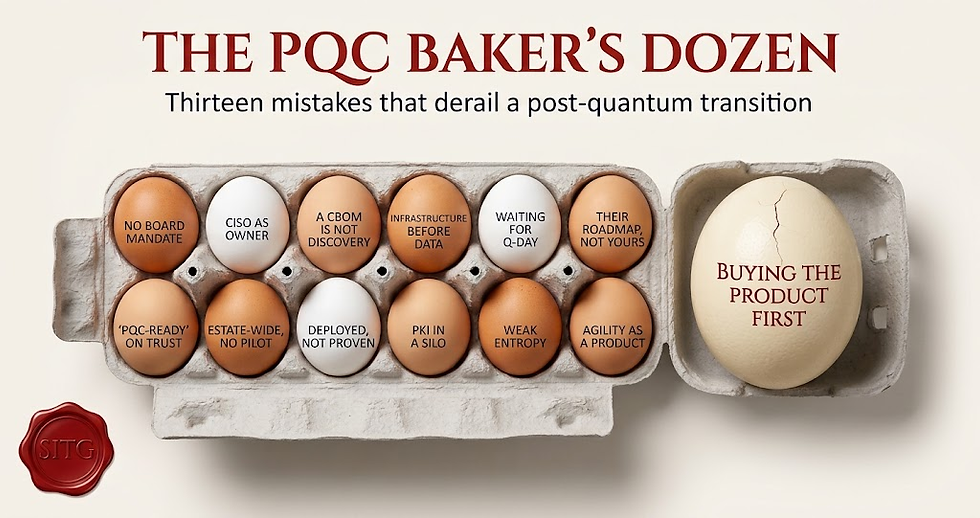
12. The Quick-Fix Merchant
The Argument
“Just upgrade OpenSSL.”
“Deploy TLS 1.3.”
“Install our appliance.”
“Replace your certificates.”
“Deploy our PQC gateway and you're covered.”
The Move
The Quick-Fix Merchant doesn't deny quantum risk. They trivialise it. They reduce a multi-year enterprise transformation programme into a technology refresh, presenting a product as though it were a strategy. The uncomfortable governance questions simply disappear.
Why it Collapses
Post Quantum Cryptography is not fundamentally a software upgrade. It is an enterprise transformation programme.
Before an organisation can replace cryptography, it must understand:
Where cryptography exists
Which business services depend upon it
Which applications use it
Which suppliers own it
Which embedded devices cannot be upgraded
Which regulations apply
How change will be governed
How migration risk will be managed
Installing a cryptographic library answers none of those questions. Replacing algorithms without understanding dependencies simply moves organisational risk from cryptography to operations.
The Quick-Fix Merchant mistakes implementation for transformation. The result is often worse than doing nothing because organisations believe they have solved a governance problem by purchasing a technology product.
Replacing a cryptographic library without understanding your estate is like replacing every lock in a city without knowing where the buildings are.
Why the PQC Denier Argument Simply Doesn’t Stack Up
Risk is time coupled, not binary. Long-lived secrets require protection before the machine exists.
Engineering trajectories change. Cooling, qubit modalities, and supply chains evolve. Governance must be ready.
HNDL is not retroactive, but it is continuous. Protecting future secrets still matters even if past ones are lost.
Identity failures don’t negate quantum risk. They are separate layers of the same security stack.
Bad timelines don’t invalidate the need for timelines. They just require better ones.
Agility is hard but mandatory. Calling it a pipe dream guarantees future failure.
Cynicism is not strategy. It’s just a clever way to avoid doing the work.
The Real Read
PQC deniers are no longer simply people who claim quantum computers will never exist. That first generation is becoming increasingly rare.
Today's deniers are more sophisticated. They accept the technology may eventually arrive, but argue there is always another reason not to act:
The standards are immature.
The timelines are unrealistic.
The algorithms might change.
Crypto agility proves the mathematics is flawed.
Identity is a bigger problem.
Vendors are overselling the risk.
A product will solve it.
Next year will be a better time to start.
Each argument sounds reasonable in isolation. Collectively, they all lead to exactly the same destination: strategic paralysis.
The irony is that cryptography has never rewarded organisations for reacting to the present. It has always rewarded those that prepare for the future.
In professional risk management, waiting until the threat is visible is not prudence.
It is failure.
Article content
Copyright Notice
© 2026 SITG-Consulting. All rights reserved. Content authored by Brian Couzens.
Legal Notice
This material contains professional analysis, commentary, and opinions. All opinions expressed are those of the author and are provided for informational and educational purposes only. Nothing in this document constitutes legal advice, regulatory guidance, or a formal security assessment.
Attribution
This work is free to share, reference, and adapt with attribution. Please cite as: Couzens, B. (2026). Anatomy of a PQC Denier. SITG-Consulting.


Comments